Jev : if-else in steroids?
I thought Jev was just another small LLM. I was wrong. So, what exactly is Jev, why do we need it, and what is it doing differently?
On this page
Models have been superhuman at chat for years, so where is all the automation? - TypeSafe
Hmm, now that's interesting, This quote from TypeSafe team was enough to hook me into this tool.
So, what problem are they trying to solve?#
TypeSafe is the team behind Jev, and their starting point is pretty simple:
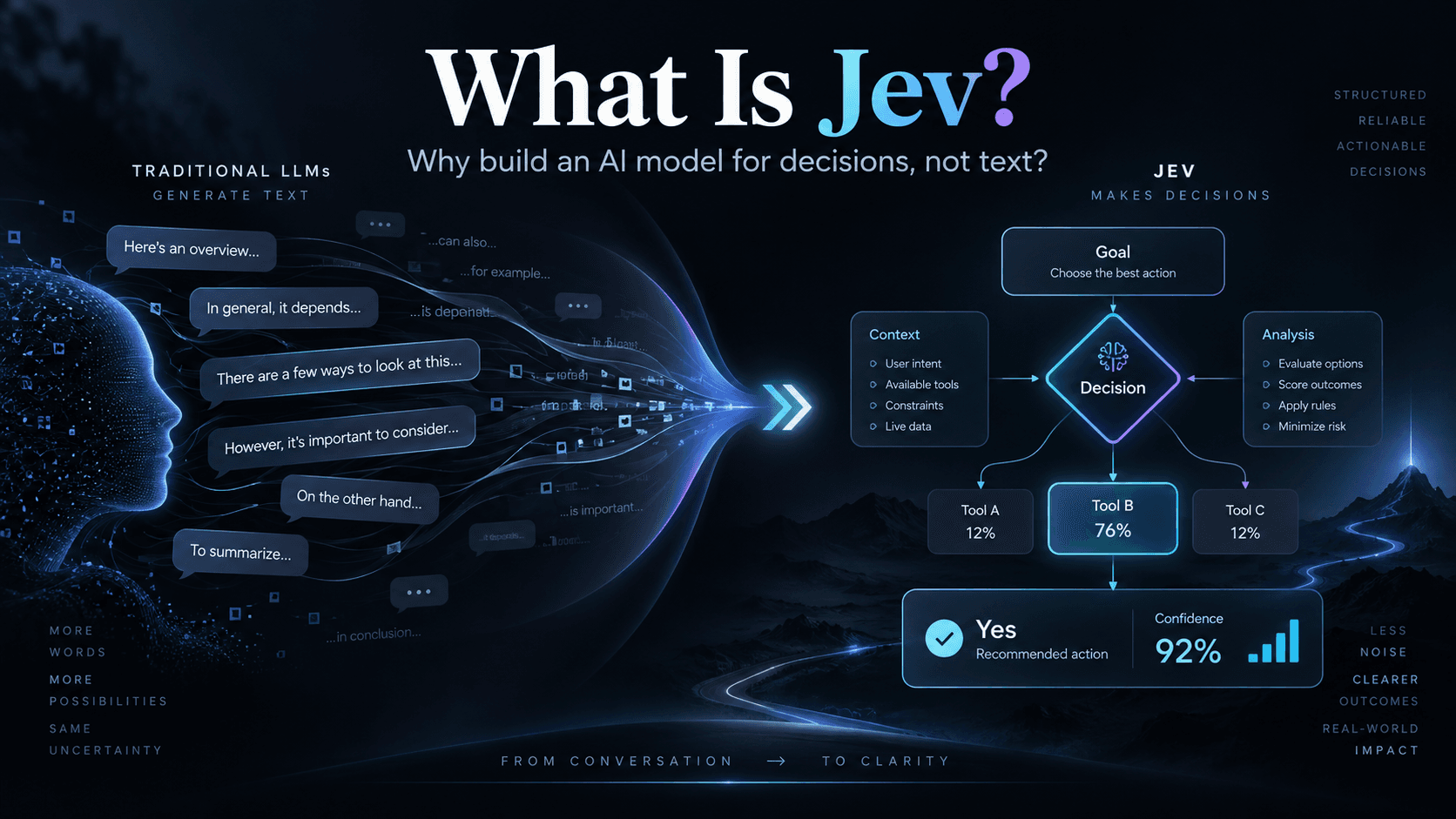
We have become really good at making AI talk. But software doesn’t always need AI to talk — sometimes it just needs AI to make a decision.
Think about it.
Does this transaction look suspicious?
Which tool should this agent use?
Where should this request be routed?
How confident are we about this decision?
For problems like these, we don’t necessarily need an AI to generate a paragraph. We need it to look at some information and make a useful decision.
And yet, today we often use an LLM to do exactly that.
So the question that caught my attention was: are we using a generation model for problems that aren't really generation problems?
That is the problem Jev is trying to approach differently. TypeSafe describes Jev as a model built specifically for “decisions inside software”, rather than arbitrary text generation.

But wait — aren’t LLMs already doing this?#
Yes. And this was my next question too.
We already use LLMs for classification, routing, tool selection, scoring, and even simple yes/no decisions. We can ask an LLM to return JSON, use structured outputs, or force it to pick from a predefined set of options.
So what is Jev actually changing?
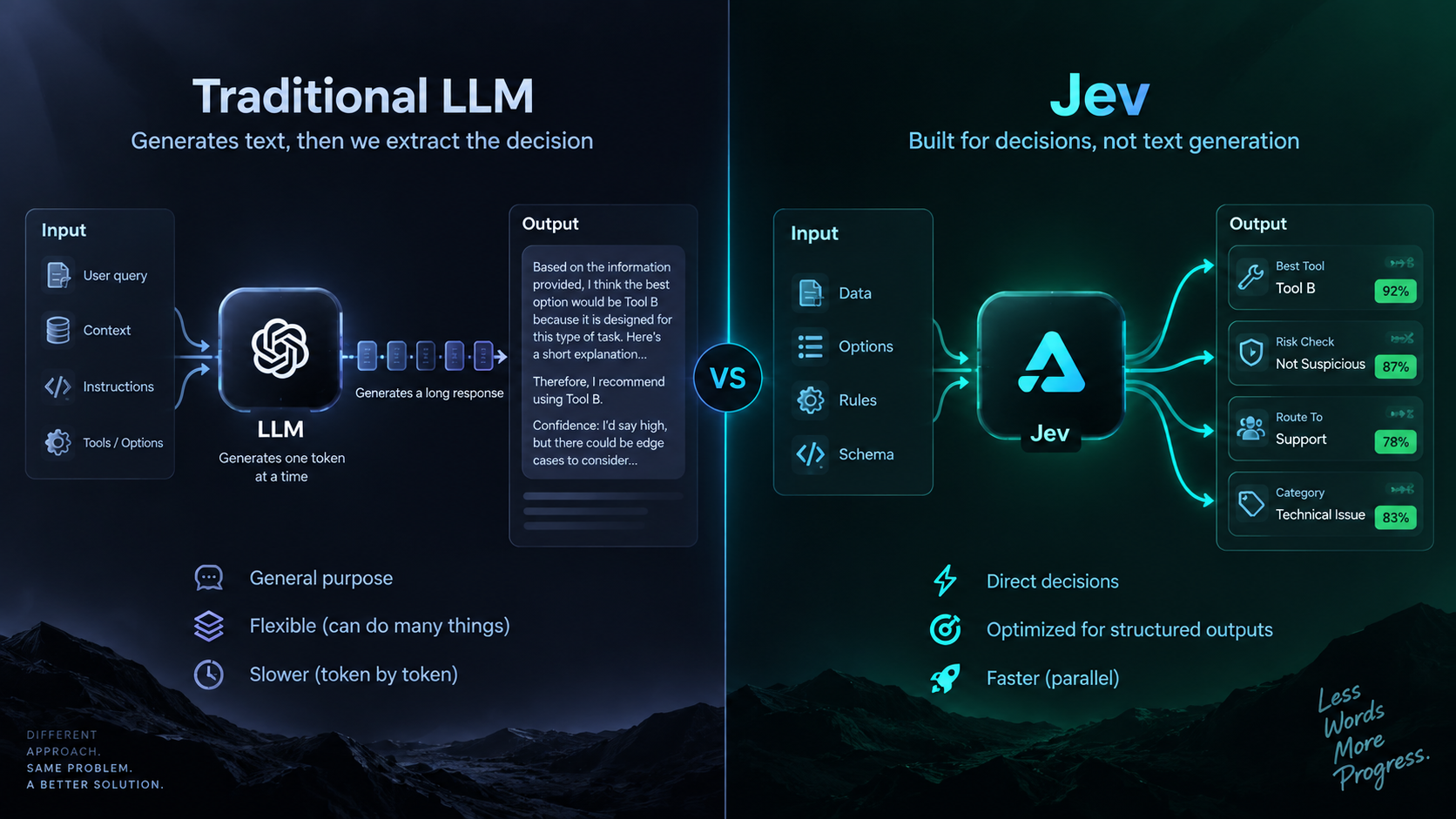
The difference is that an LLM is still fundamentally built to generate a sequence of tokens. We are taking that generation system and constraining it until it behaves like a decision-maker.
Jev starts from the opposite direction.
It doesn't try to generate an arbitrary response at all. You define the decisions your software needs, and Jev returns typed choices along with probabilities and confidence that the software can use directly. TypeSafe also says these outputs are produced in parallel rather than being generated one token at a time.
So maybe the distinction is:
- LLM: “Let me generate the answer you asked for.”
- Jev: “Tell me which decisions your software needs me to make.”
And this is where Jev stopped looking like a small LLM to me and started looking like something built for a different job entirely.
The next question for me was obvious.
Why Jev, when LLMs can already do all of this — and more?#
LLMs can already classify things, select tools, route requests, score options, return structured JSON — and on top of that, they can write, reason, code, summarize, and do a lot more.
So why build an entirely different model just for decisions?
The answer seems to be: because being able to do something doesn’t necessarily mean you’re optimized to do it.
An LLM is incredibly flexible, but that flexibility comes from generating strings token by token. If all my software needs is:
- Which tool?
- Yes or no?
- Which route?
- How confident are you?
...then generating language may be unnecessary work.
Jev gives up that general-purpose text generation and focuses specifically on structured decisions that software can consume directly. TypeSafe says this lets it return multiple decisions in parallel, attach probabilities and confidence to them, and do this much faster and more cheaply for these kinds of tasks.
And that gave me a much simpler way to think about it:
An LLM is a general-purpose intelligence interface. Jev is trying to be a decision primitive for software.
That naturally leads into the next question:
Okay, but what did Jev actually change to make that possible?#
This is where I initially expected to find some trick that simply made an LLM smaller or faster.
But TypeSafe seems to have changed the problem itself.
An LLM is trained around generating strings. Jev is built around making predefined decisions.
So instead of asking:
“Read this situation and generate an answer.”
we can define beforehand what we actually need:
- Is this suspicious? → Yes / No
- Which tool? → A / B / C
- Risk level? → Low / Medium / High
Jev then returns probabilities over those possibilities rather than generating an explanation first and extracting the answer afterward.
That change leads to three important differences TypeSafe talks about:
- A different model architecture built around structured decisions.
- A parallel sampler, so multiple outputs can be produced together instead of token → token → token.
- A different training method called RLCD — Reinforcement Learning for Calibrated Decisions, which trains the model to produce useful decisions and meaningful probabilities around them.
So the simplest mental model I have right now is:
- LLM: generate something, then find the decision inside it.
- Jev: define the possible decisions first, then predict them directly.
That sounds simple, but it raises a much more interesting question for me:
If Jev isn’t generating text, how is it actually making decisions?#
This is where the idea gets more interesting.
Jev still takes in context — text, state, options, whatever your software gives it. But instead of trying to continue that context as a sequence of words, it looks at the predefined decisions you care about and estimates them directly.
So conceptually, instead of:
Input → think in text → generate tokens → parse the answer
it is closer to:
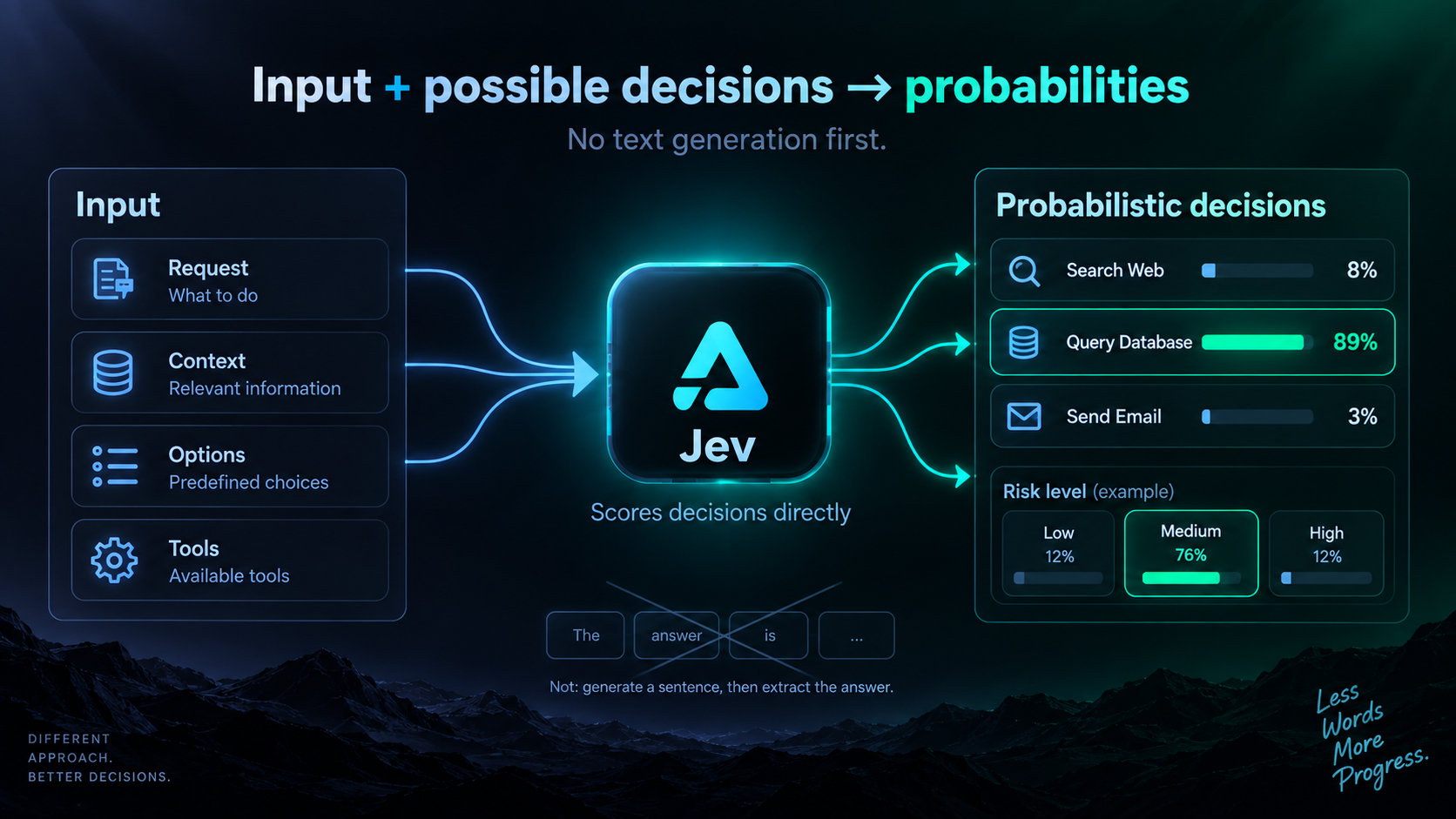
Input + possible decisions → score those decisions → return probabilities
That’s why TypeSafe describes Jev as:
“Unstructured state in, typed probabilistic decisions out.”
For example, imagine my agent has three tools:
- Search Web
- Query Database
- Send Email
With an LLM, I might ask it to reason about the request, generate some text or JSON, and then extract which tool it chose.
With Jev, those three choices are already defined. The model’s job is essentially to evaluate them and return something like:
- Search Web — 8%
- Query Database — 89%
- Send Email — 3%
And this happens without autoregressively generating a sentence first. TypeSafe says Jev uses a parallel sampling approach, where its outputs can be produced together rather than one token after another.
This also helped me understand the name “System One Model.”
TypeSafe says the name is inspired by the System 1 / System 2 distinction from Thinking, Fast and Slow: System 1 being fast and intuitive, while System 2 is slower and more deliberate. Jev is being positioned much closer to the first category — fast decisions rather than long-form deliberation.
But where do those probabilities come from — and can we trust them?#
This part matters because returning “Tool B — 92%” is only useful if that 92% actually means something.
LLMs can also tell us they are “90% confident.” But that number is usually just more generated text. It is not necessarily calibrated to how often the model is actually correct.
Jev is designed differently.
TypeSafe says Jev is trained using something they call RLCD — Reinforcement Learning for Calibrated Decisions. Instead of optimizing primarily for responses that humans prefer, the goal is to make the model’s probabilities line up with how reliable its decisions actually are.
The intuition is simple:
If Jev says 90% confidence across many similar decisions, we would ideally expect it to be correct roughly 90% of the time.
That becomes useful inside software because now confidence itself can become part of the logic:
- 95% → act automatically
- 70% → maybe run another check
- 40% → ask a human
So Jev isn't only trying to answer:
“What should I do?”
It is also trying to answer:
“How sure am I that I should do it?”
And that makes the probability more than just a nice number on the screen. It can actually become part of the program. TypeSafe explicitly positions this as a way for developers to set thresholds for autonomous action versus review.
But there’s an important distinction here: calibrated does not mean always correct. Jev can still make the wrong decision. The idea is that its uncertainty should help the surrounding software decide when it is safe to trust the model and when it should fall back, verify, or escalate.
And that’s probably the part I find most interesting about Jev.
I’m not looking at it as a replacement for LLMs, and I haven’t tested it deeply enough to make that kind of claim anyway. What it does seem to challenge is the assumption that every intelligent software task needs a general-purpose language model behind it.
So maybe the more interesting question is:
How many things are we currently using LLMs for that never needed language generation in the first place?